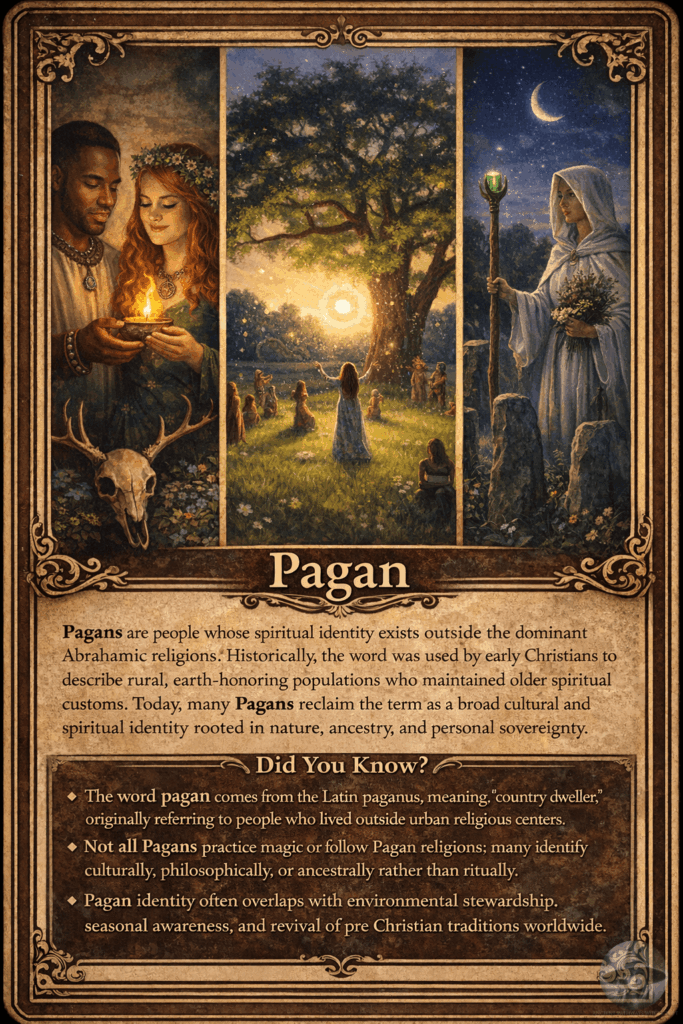

The word Pagan describes people whose spiritual identity exists outside the dominant Abrahamic religions. Historically, it was a label applied by early Christians to rural communities who continued to honor older, land-based spiritual customs. What began as an external classification has, over time, become a reclaimed identity for many.
Pagans are not united by a single belief system. Instead, the term serves as a broad umbrella that includes a wide range of spiritual, cultural, and ancestral paths. Some Pagans follow ancient polytheistic traditions, such as Greek, Norse, or Celtic ways. Others hold a more animistic or philosophical relationship with the natural world, honoring spirit, land, and cycle without formal ritual or deity worship.
A common thread among Pagan people is attentiveness to nature and time. Seasonal changes, solar and lunar cycles, and the rhythms of life often serve as guides for reflection and celebration. This may take the form of festivals, quiet observance, community gatherings, or personal practice shaped by place and lineage.
Today, many Pagans understand their path not as a fixed doctrine, but as a lived relationship with the world around them. Pagan identity often emphasizes personal responsibility, respect for the Earth, and a sense of belonging within the wider web of life. It is less about belief alone and more about participation, presence, and continuity with what came before.
Pagans are not united by a single belief system. Instead, the term serves as a broad umbrella that includes a wide range of spiritual, cultural, and ancestral paths. Some Pagans follow ancient polytheistic traditions, such as Greek, Norse, or Celtic ways. Others hold a more animistic or philosophical relationship with the natural world, honoring spirit, land, and cycle without formal ritual or deity worship.
A common thread among Pagan people is attentiveness to nature and time. Seasonal changes, solar and lunar cycles, and the rhythms of life often serve as guides for reflection and celebration. This may take the form of festivals, quiet observance, community gatherings, or personal practice shaped by place and lineage.
Today, many Pagans understand their path not as a fixed doctrine, but as a lived relationship with the world around them. Pagan identity often emphasizes personal responsibility, respect for the Earth, and a sense of belonging within the wider web of life. It is less about belief alone and more about participation, presence, and continuity with what came before.