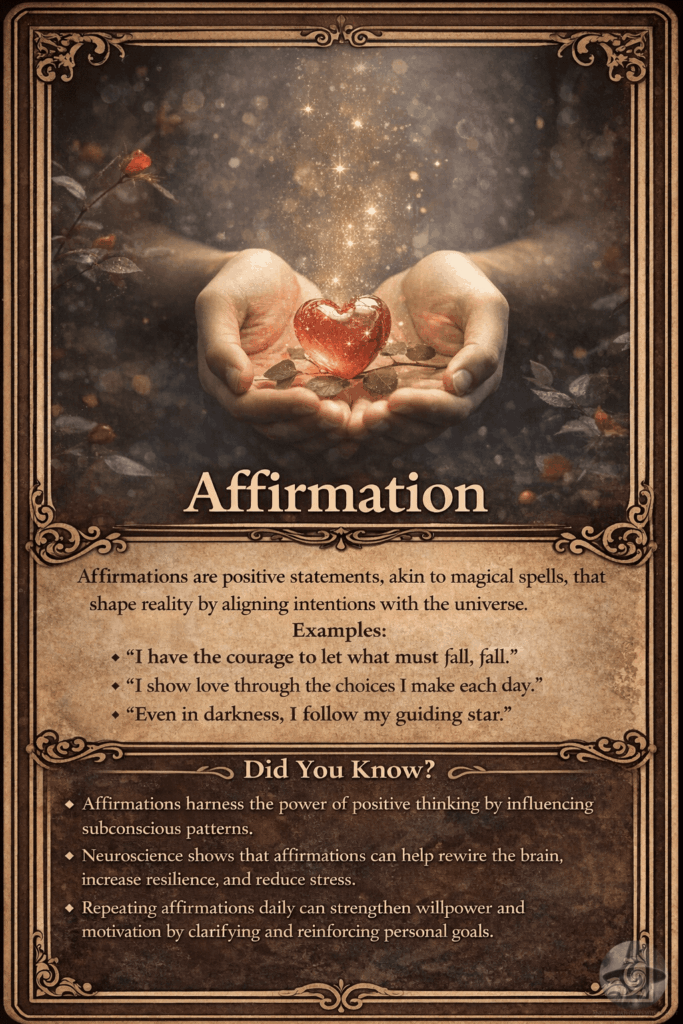

An intentional statement used to shape thought, guide focus, and support inner change. Across history and cultures, people have used spoken words to align intention with action, belief, and meaning. Whether spoken aloud, written, or held silently, affirmations help direct attention toward what matters most.
At their simplest, affirmations work by choosing language with care. Words influence how we think, and repeated thoughts influence how we act. An affirmation creates a steady point of focus, reminding the mind what it is moving toward rather than what it fears or resists.
What Is an Affirmation?
An affirmation is a positive, conscious statement spoken in the present tense. It names a desired state as if it is already unfolding. Rather than forcing belief, affirmations invite awareness. Over time, they help shift inner dialogue, reinforce intention, and encourage consistency between thought, choice, and behavior.
Affirmations do not deny difficulty. Instead, they offer direction. They act as a compass rather than a command.
Through History
Throughout history, affirmations appeared in prayer, chant, hymn, and mantra. Ancient Egyptian priests used spoken declarations during ritual. Greek philosophers emphasized the power of intentional speech. Vedic traditions relied on repeated mantras to steady the mind and align with cosmic order.
In many cultures, people understood that words carried weight. Repetition strengthened meaning, and meaning shaped experience.
Across Cultures
Affirmations appear in many forms across traditions. Buddhist practices use repeated phrases to cultivate compassion and clarity. Indigenous cultures employ affirming chants during ceremony and healing. In modern psychology, affirmations support self-regulation, confidence, and emotional resilience.
Although methods differ, the purpose remains similar: to guide attention, reinforce values, and support inner balance.
Spiritual Practice
In witchcraft and other spiritual paths, affirmations function much like incantations. They combine intention, emotion, and language into a focused act. When spoken during ritual, meditation, or daily practice, affirmations help align inner intention with outward action.
Used this way, an affirmation becomes both a promise and a practice. It does not impose change, but invites it.
Working With Affirmations
Effective affirmations feel honest and reachable. They reflect growth rather than perfection. Many people pair affirmations with breath, visualization, journaling, or ritual to deepen their impact.
Consistency matters more than force. When repeated with care, affirmations help create steady change over time.